
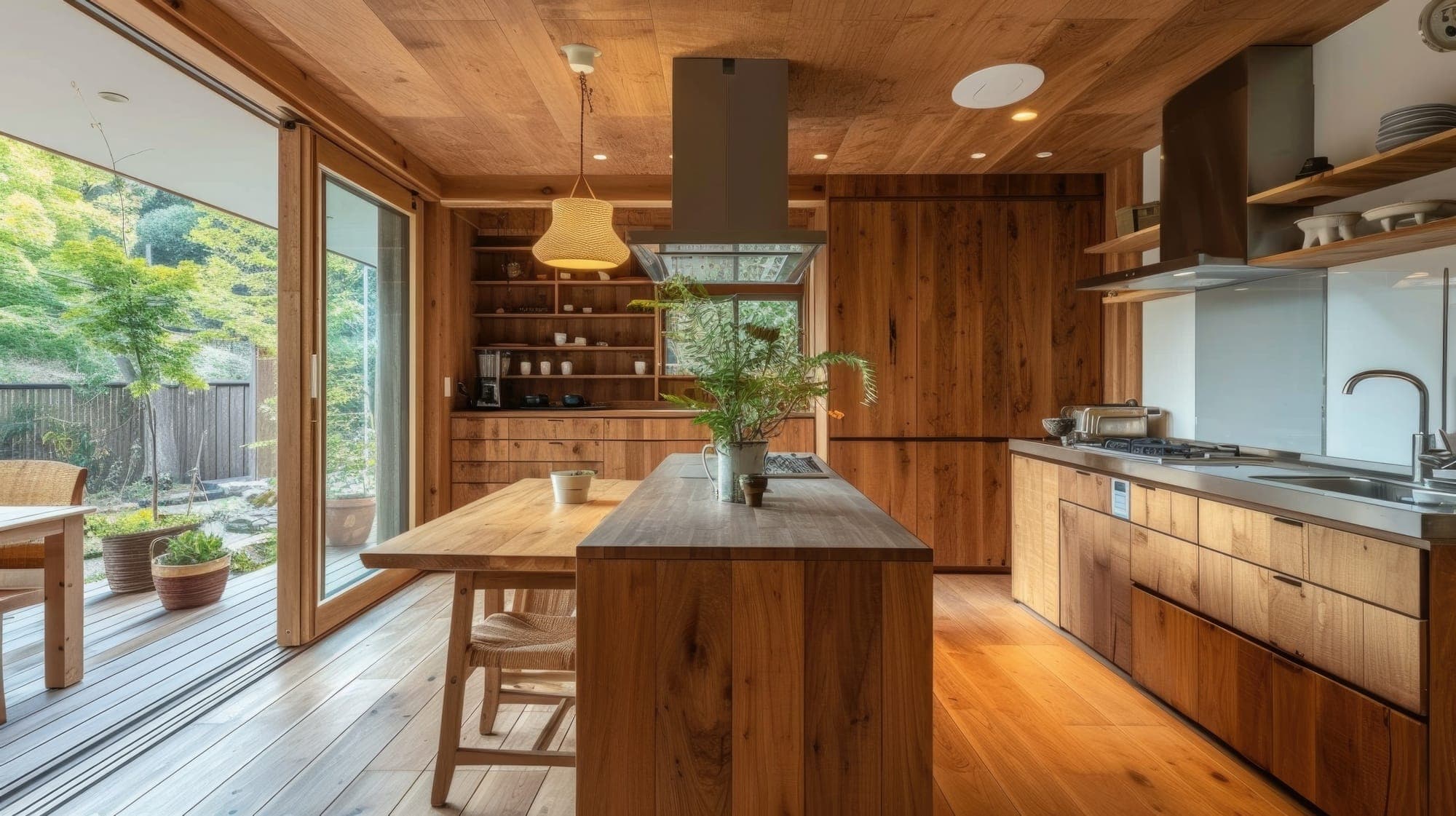
"How much will it cost?" is the first question almost every client asks, and the honest answer is that bespoke joinery has no fixed price list. Two kitchens of the same size can differ several times over in cost depending on what goes into them. That is not a reason to go in blind, though. The price of custom joinery is driven by a small number of factors, and once you understand them you can budget with confidence and decide where your money makes the most difference. This guide explains each one.
Why bespoke joinery is priced per project
Ready-made furniture is priced per unit because every unit is identical. Bespoke joinery is designed for one space, so each project has its own combination of size, materials, finishes, hardware and detailing — and its own amount of design, drawing, workshop and installation time. That is why a reliable quotation always comes after a brief and a design direction, not before.
What you can do early is get an indicative range. Our online cost estimator gives an instant AED range for kitchens, wardrobes, bathrooms, living rooms, bedrooms and office areas, based on the size of the space and the options you select. It is a planning tool, not a quotation, but it shows how each choice moves the price.
1. Size and scope
The single biggest driver is simply how much joinery there is. Most joinery is measured by area — square metres of cabinetry, wall panelling or wardrobe frontage — plus individual items such as an island, a vanity or a TV unit. A full-height wardrobe wall costs more than a waist-height unit of the same width; a kitchen with tall larder units and an island costs more than a single run of base and wall cabinets.
Scope also means how many rooms are involved. A whole-home fit-out — kitchen, wardrobes, vanities, a TV wall and doors — benefits from being designed and built together, with consistent materials and one installation programme.
2. Materials
The board and materials behind the finish affect both price and performance. Moisture-resistant boards cost more than standard boards, but in kitchens, bathrooms and anywhere near water they are worth it, particularly in Dubai's humid climate. Solid timber elements, specialist boards and stone or quartz worktops all add cost compared with standard options.
Worktops deserve a special mention because they are often a large share of a kitchen budget. Quartz and porcelain are popular for durability; natural marble is chosen for its look but needs more care; exotic stones sit at the top of the range. The countertop decision usually moves a kitchen's price more than any single cabinet choice.
3. Finishes
The finish is one of the clearest ways to control cost, because the same cabinet can be finished in very different ways:
- Melamine and laminate are the most economical, hard-wearing and easy to clean.
- Lacquer or paint costs more because of the preparation, spraying and curing involved, and gives a seamless, colour-matched surface.
- Natural wood veneer sits at the premium end, with matched real-timber grain across panels.
In our cost estimator, lacquer is modelled at roughly 15% above melamine and veneer at roughly 35% above, which reflects how much the finish alone can change a price. For a closer look at the trade-offs, read painted vs. veneered finishes or browse our wood finishes.
A common way to balance a budget is to spend on the finishes people see and touch every day, and choose practical, hard-wearing finishes for interiors and back-of-house storage.
4. Hardware and fittings
Hinges, drawer runners, handles, lift-up mechanisms, pull-out larders, corner solutions, internal organisers and lighting all add up. Quality hardware costs more upfront, but it decides how the joinery feels every day and how long it keeps working. Soft-close, full-extension runners and well-made hinges are rarely where we would suggest saving money, particularly in a kitchen.
Specialist fittings — motorised lifts, integrated lighting with sensors, pocket doors, hidden safes — are where costs can climb quickly. They are worth it when they solve a real problem, and easy to cut when they do not.
5. Design complexity and detailing
Straight runs of standard-depth cabinets are the most efficient to make. Curves, angled walls, handleless profiles, integrated appliances, open shelving with concealed fixings, grain-matched panels and joinery that wraps around corners all take more design, drawing and workshop time. None of this is a reason to avoid detail — it is often what makes a project feel bespoke — but it is a reason to decide where detail matters most.
Complexity also includes the site. Walls that are out of square, ceilings that are not level and services that run where the joinery needs to go all add work, which is why site verification happens before final drawings.
6. Design, drawings and project management
With a bespoke project, part of what you pay for is the work that happens before anything is built: understanding the brief, developing the design and producing full technical shop drawings for approval. This stage is what makes sure what gets built is exactly what you approved. It also tends to save money overall, because mistakes caught on paper cost far less than mistakes caught on site.
7. Installation
Installation is usually the fastest stage of a project, because everything arrives pre-made to the approved dimensions — but it still needs to be priced. Access to the site, the floor the project is on, working-hour restrictions in some buildings, and the amount of scribing needed to fit joinery to walls all affect installation time. Our own installation team carries out every installation rather than subcontracting it.
How to get an accurate quotation
You will get a faster and more accurate quotation if you can share:
- The type of space and rough dimensions, or a floor plan
- Photos of the site as it is today
- Reference images of styles, colours and finishes you like
- A list of what needs to be stored or accommodated
- Your budget range and preferred timeline
None of this needs to be perfect. During the consultation we gather the full brief and then prepare a design direction, scope and quotation for you to review.
Where to spend and where to save
Every project is different, but a few patterns hold true:
- Spend on layout and planning — getting the design right costs far less than changing it later.
- Spend on hardware you use daily, especially in kitchens and wardrobes.
- Choose the premium finish for the surfaces people see, and a practical finish inside cabinets and in utility areas.
- Be selective with specialist fittings — keep the ones that solve real problems.
- Make decisions promptly during drawing approval; delays and late changes add cost.
Bringing it together
The price of custom joinery comes down to how much there is, what it is made of, how it is finished, the hardware inside it, how complex it is to make and how it is installed. Understanding those factors lets you shape a design around your budget rather than discovering the cost at the end. Try our cost estimator for an instant indicative range, then book a consultation for a detailed quotation for your space.
Tell us about your space — our design team will walk you through material and finish options for your project.
Enquire Now →